Psalm 91 Origins and History in Hebrew: What Ancient Scholars Teach Us
Psalm 91 was likely written by Moses after witnessing God’s protection in the wilderness, and the Hebrew language itself reveals layers of meaning about divine protection that most English readers miss.. The more we understand about the psalm’s Hebrew background — its language, its ancient context, and the traditions that have gathered around it — the richer and more powerful its words become. This article explores the origins of Psalm 91, the debate over its authorship, its place in ancient Jewish life, and what the Hebrew language itself reveals about its extraordinary promises.
Who Wrote Psalm 91?
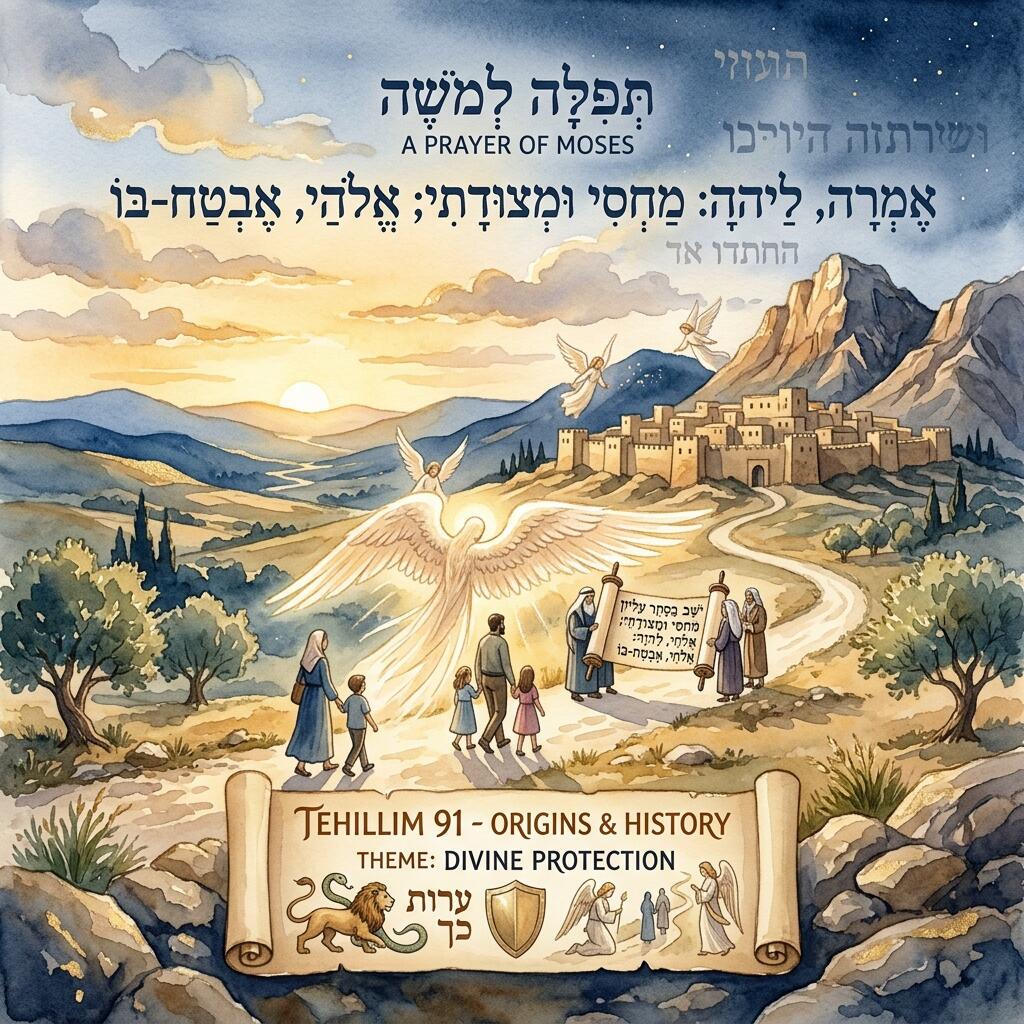
Unlike many psalms, Psalm 91 carries no superscription in the Hebrew text — no attribution to David, Asaph, or the Sons of Korah. The Jewish Talmud (Berakhot 10a) attributes the psalm to Moses, an attribution explored further in our complete guide to Psalm 91, and this tradition has been widespread in both Jewish and early Christian interpretation. The Septuagint adds “A praise song of David” to its heading, reflecting a different tradition.. {‘rendered’: ‘Psalm 91 for Soldiers, Police, and First Responders. {‘rendered’: ‘5 Powerful Promises of Protection in Psalm 91’}. {‘rendered’: ‘Psalm 91 Meaning Verse by Verse
Those who favour Mosaic authorship point to the use of El Shaddai (Almighty) in verse 1 — a divine name especially prominent in the Pentateuch. They also note that Psalm 90, which immediately precedes Psalm 91 and is explicitly attributed to Moses, deals with similar themes of God’s eternal nature and human vulnerability. It is plausible that Psalms 90 and 91 were written as a pair — Psalm 90 reflecting on human mortality, and Psalm 91 responding with the security available to those who trust in the eternal God.
Key Hebrew Words and Their Significance
Seter (secret place, verse 1) — This word appears eighteen times in the Old Testament and consistently denotes a place of concealment or protection. God’s shelter is not merely atmospheric — it is a specific, real hiding place.
Tsinnah and sochera (shield and buckler, verse 4) — These two words describe complementary pieces of military equipment. Together they convey comprehensive protection. The word sochera is rare — appearing only here in the entire Old Testament.
Dever (pestilence, verse 6) — In the ancient world, pestilence was perhaps the most dreaded form of mass death. The word appears in connection with the plagues of Egypt and with the divine judgements in Ezekiel and Jeremiah. God’s protection from dever was a promise of extraordinary comfort. See our full verse-by-verse analysis for more on these specific promises.
Psalm 91 in Ancient Jewish Life and Liturgy
Psalm 91 has occupied a uniquely important place in Jewish liturgy throughout history. In the Talmud, it is called the “Psalm of Pestilences” (Shir shel Pega’im) and was recited as protection against evil spirits and disease. It was traditionally said at the conclusion of the Sabbath, when the protective cloud of Sabbath peace was lifting.
Among the Dead Sea Scrolls (texts from the community at Qumran), fragments of Psalm 91 were found alongside texts used in exorcistic rituals. The psalm was believed to have special power against demonic forces — a usage that coheres with its imagery of treading on lions and serpents.
The Psalm in Its Ancient Near Eastern Context
What distinguishes Psalm 91 from its ancient parallels is the character of the protecting God. In Mesopotamian texts, protection came through ritual manipulation of divine powers. In Psalm 91, protection comes through relationship: “because he has set his love on me” (verse 14, WEB). The entire structure of Psalm 91 is relational rather than ritualistic. You are protected not because you performed the right ceremony but because you know and love the right Person.
A Closing Prayer
God of history, you inspired these words thousands of years ago and they are as alive today as the day they were first spoken. Thank you for a psalm that has sheltered generations of your people — soldiers and exiles, parents and pilgrims, the sick and the fearful. Let these ancient words find their home in my heart. As I meditate on them, let the Spirit who inspired them illuminate their meaning for my life today. In your faithful name, Amen.