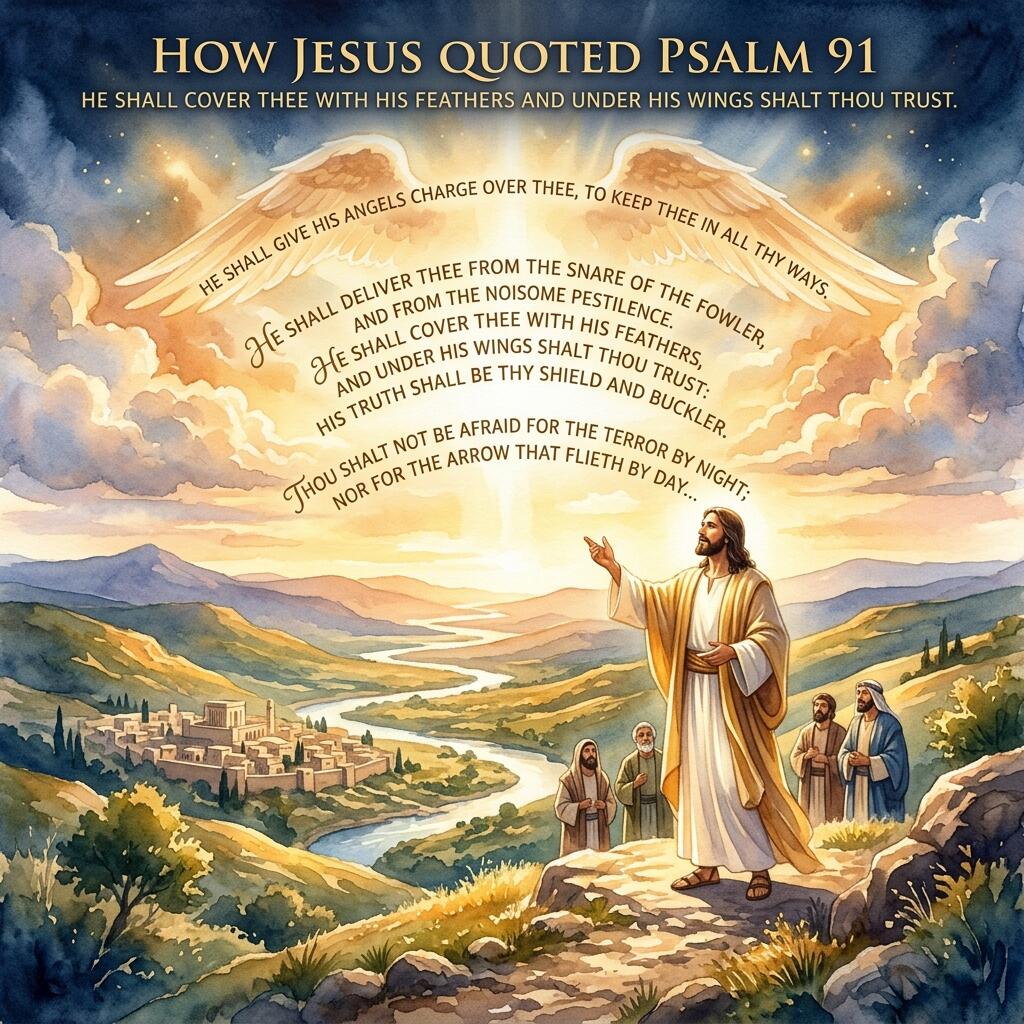
How Jesus Quoted Psalm 91: The Temptation in the Wilderness and Beyond
Perhaps the most fascinating episode in the New Testament involving Psalm 91 is not one in which Jesus cited the psalm approvingly — it is one in which his adversary did. In Matthew 4 and Luke 4, Satan quotes Psalm 91:11–12 to Jesus during the wilderness temptation, and Jesus refuses to act on it. This encounter reveals something important about how Psalm 91 was understood in the first century, how it can be misused, and what Jesus’ own relationship with this ancient song of protection truly was.
The Wilderness Temptation: Satan Quotes Psalm 91
The scene is the wilderness of Judea. Jesus has fasted for forty days and nights and is at his physical weakest. Satan comes with three temptations, and the second involves a trip to the pinnacle of the temple in Jerusalem. There, Satan quotes Scripture: “If you are the Son of God, throw yourself down, for it is written, ‘He will put his angels in charge of you’; and, ‘On their hands they will bear you up, so that you won’t dash your foot against a stone.'” (Matthew 4:6, WEB). This is a direct quotation of Psalm 91:11–12.
Jesus refuses. His response is: “You shall not test the Lord your God.” (Matthew 4:7, WEB). This refusal tells us several crucial things. First, Jesus knew Psalm 91 well enough to recognise that Satan was applying it out of context. The psalm’s protection is for those who walk “in all your ways” — that is, in God’s paths, not in self-willed tests. It is also worth noting what Satan omitted: the full Psalm 91:11 reads “to guard you in all your ways” — Satan dropped the crucial qualification.
Jesus as the True Dweller in the Secret Place
Jesus himself is the supreme exemplar of what Psalm 91 describes. He is the one who truly dwells in the secret place of the Most High — who lives in perfect, unbroken communion with the Father. When believers are “in Christ,” they share in Jesus’ position as the one who dwells in God’s presence. The protection of Psalm 91 becomes available not because believers have achieved perfect spiritual dwelling themselves, but because they are united with the one who has.
Jesus and the Authority of Psalm 91:13
In Luke 10:17–19, seventy-two disciples return from a mission with joy, reporting that demons submit to them in Jesus’ name. Jesus responds: “Behold, I give you authority to tread on serpents and scorpions, and over all the power of the enemy. Nothing will in any way hurt you.” (Luke 10:19, WEB). This is an unmistakable echo of Psalm 91:13. Significantly, Jesus immediately adds: don’t rejoice in authority over demons; rejoice that your names are written in heaven. The relationship is primary; the authority flows from it.
Psalm 91 and the Resurrection of Christ
Some early Christian interpreters saw Psalm 91:14–16 as a prophetic preview of the resurrection. The promise “I will deliver him, and honor him. I will satisfy him with long life” takes on new depth when applied to Christ: delivered from death, honoured by the Father, given eternal life. For the Christian, the resurrection means that every promise of Psalm 91 is sealed in the most dramatic way imaginable. These are promises from the one who has already demonstrated his power over death itself.
A Closing Prayer
Lord Jesus, you stood firm in the wilderness when the enemy tried to twist your Father’s promises. Give me the same discernment — to hold Psalm 91’s promises rightly, within the full counsel of Scripture, as commitments for those who walk faithfully in your ways. Thank you for being the true dweller in the secret place, and for welcoming me into that place through your death and resurrection. Amen.