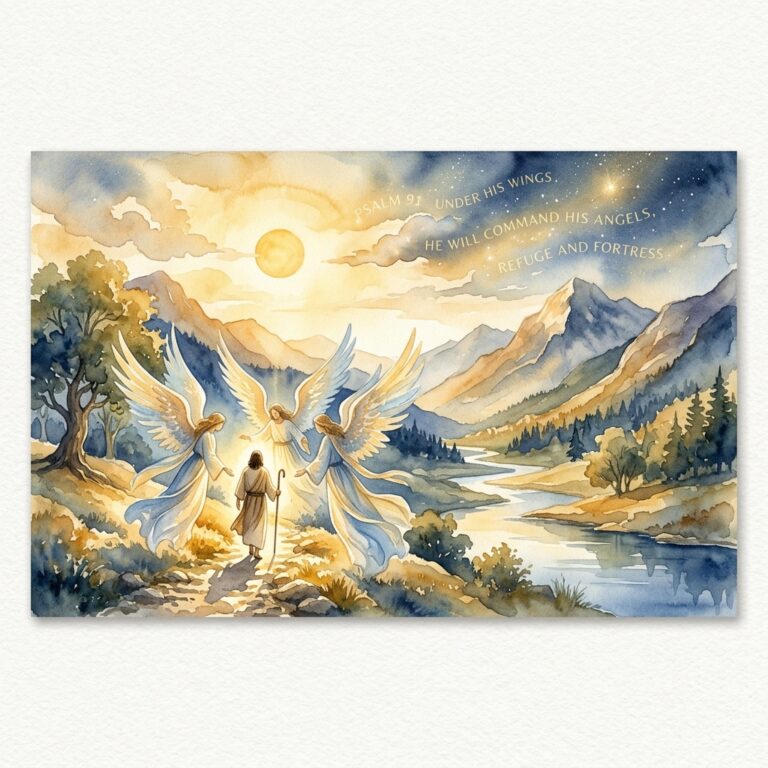
The Meaning of ‘He Will Cover You With His Feathers’ — Psalm 91:4 Explained
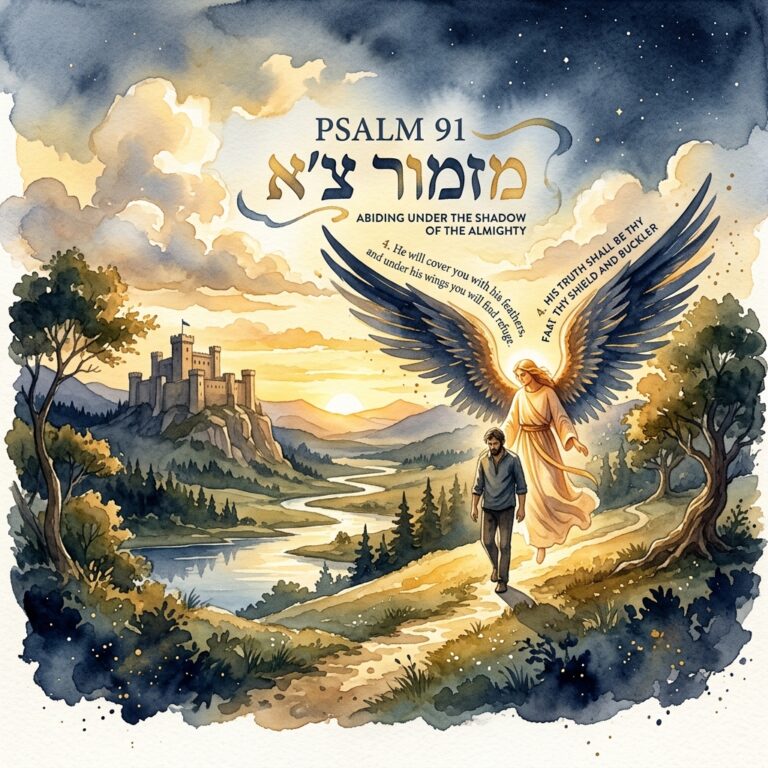
The image of God covering you with His feathers and sheltering you under His wings is not poetic sentimentality but a declaration that you are held, protected, and loved with the intense care of a mother bird defending her chicks..” What does it mean that God covers us with His feathers? What was the original Hebrew saying? And what does this ancient image mean for believers today? This is a deep dive into one of the most beloved verses in all of Scripture.
Learn more about the role of guardian angels in Psalm 91.. {‘rendered’: ‘Psalm 91 Meaning Verse by Verse. {‘rendered’: ‘5 Powerful Promises of Protection in Psalm 91’}. {‘rendered’: ‘Praying Psalm 91 Over Your Family
The Hebrew Words Behind the Image
The richness of Psalm 91:4 is only fully appreciated when we look at the original Hebrew text. This verse complements the shield and buckler imagery explored in our companion article.
1. “Pinions” — Evrah (אֶבְרָה)
The Hebrew word evrah refers specifically to the strong primary feathers of a bird — the large outer feathers that enable flight and form the protective canopy of a wing. These are not soft, fragile feathers; they are strong, resilient, and structured for power. When the psalmist says God will cover you with His evrah, it invokes strength — the mighty, capable covering of a God who has the power to protect what He shelters.
2. “Wings” — Kanaph (כָּנָף)
The Hebrew word kanaph is broader and more versatile than evrah. It means wings, but also the corner of a garment, the edge of a robe. This dual meaning is significant: in the ancient Near East, spreading one’s garment or robe over someone was a formal act of protection, adoption, and covenant love. When Boaz spread his robe over Ruth (Ruth 3:9), he was using this very gesture — the same word — to declare his intention to be her protector and redeemer. God spreading His kanaph over His people is not merely biological imagery; it is covenantal language. He is declaring: I claim you. I cover you. You belong to me.
3. “Refuge” — Chasah (חָסָה)
The word translated “refuge” — chasah — means to flee for protection, to take shelter, to trust in someone as a place of safety. It is a dynamic word: it describes not a static place but an active running toward safety. “Under his wings you will chasah” — you will run to Him, you will take cover, you will find that He is the kind of shelter that holds. This is the same word used throughout the Psalms for trusting in God (Psalm 2:12, 5:11, 7:1). To trust God is to run to Him for cover.
The Cultural Context: Birds and Protection in the Ancient World
To understand why the feathers/wings imagery is so powerful in Psalm 91, we need to understand how ancient Israelites related to birds — particularly eagles and mother hens.
The Eagle in Hebrew Thought
The eagle was the supreme symbol of strength, protection, and sovereignty in the ancient Near East. Deuteronomy 32:11–12 uses eagle imagery to describe God’s care for Israel in the wilderness: “Like an eagle that stirs up its nest, that flutters over its young, spreading out its wings, catching them, bearing them on its pinions, the LORD alone guided him.”
Ancient observers noted that eagles teach their young to fly by pushing them from the nest, then swooping underneath to catch them on their wings. This was not cruelty — it was the development of strength. God’s protective care, described in eagle imagery, includes both the covering that shelters and the sometimes-difficult process that produces growth.
The Mother Hen in Jewish and Christian Tradition
While the eagle imagery speaks of power, the imagery of a mother hen speaks of tenderness. Jesus Himself employed this image in Matthew 23:37: “How often would I have gathered your children together as a hen gathers her brood under her wings, and you were not willing!” The longing in Jesus’ voice is unmistakable — it is the longing of a mother hen whose chicks will not come in from the storm.
In ancient farming communities, observers knew that a mother hen would sacrifice herself for her chicks. In a fire or a storm, she would spread her wings over her brood and refuse to abandon them, even at the cost of her own life. Early church fathers saw in this image a foreshadowing of Christ’s death on the cross — the ultimate act of sheltering love, where He spread His arms wide and absorbed the storm so that we could live.
The Theological Significance of the Wings Image
The feathers and wings imagery in Psalm 91:4 carries at least four layers of theological meaning:
1. Intimacy
Being under someone’s wings is not a distant relationship. It is close, warm, and personal. God’s protection is not bureaucratic or remote — it is the protection of One who draws you close to Himself. The safest place in the universe is not a bunker or a fortress; it is near the heart of God.
2. Vulnerability Welcomed
A chick under its mother’s wing is entirely dependent. It cannot protect itself. The wings image suggests that God’s protection is available to those who are willing to admit they need it — who come to Him not in self-sufficiency, but in humble dependence. The proud do not run under God’s wings; the humble do.
3. Covenant Love
As we saw in the Hebrew, the kanaph imagery is covenantal. God covering you with His wings is not a random act of kindness — it is a formal declaration of covenant relationship. You are His. He has claimed you. This is the language of belonging, of adoption, of being brought into the family of God. For New Covenant believers, this finds its ultimate expression in the cross, where Christ bore the penalty for sin and brought us into permanent relationship with the Father.
4. Active Protection
Wings are not static. They move, they adjust, they respond. The feathers that cover you are not stone walls — they are living, responsive protection. This captures something important about how God protects: He is not a passive barrier but an active guardian who responds to threats, who moves to cover, who adjusts His protection to meet the specific danger you face.
How This Verse Appears in the Rest of Scripture
Psalm 91:4 does not stand alone — the wings imagery runs like a golden thread through the entire Bible:
- Exodus 19:4: “I carried you on eagles’ wings and brought you to myself.” — God describes the Exodus itself as a carrying on wings.
- Ruth 2:12: Boaz blesses Ruth: “May the LORD repay you for what you have done. May you be richly rewarded by the LORD, the God of Israel, under whose wings you have come to take refuge.”
- Psalm 17:8: “Hide me in the shadow of your wings.”
- Psalm 36:7: “How precious is your steadfast love, O God! The children of mankind take refuge in the shadow of your wings.”
- Psalm 57:1: “In the shadow of your wings I will take refuge, till the storms of destruction pass by.”
- Malachi 4:2: “But for you who fear my name, the sun of righteousness shall rise with healing in its wings.”
From the Exodus to the prophets to the Psalms, the image of God’s sheltering wings is one of the most consistent and beloved in all of Scripture.
What “He Will Cover You With His Feathers” Means for You Today
For the believer in the 21st century, Psalm 91:4 carries the same power it has always carried — perhaps even more, given how exposed and unprotected modern life can feel.
When you read that God will cover you with His feathers, you are being reminded of several truths simultaneously: that He is powerful enough to protect you (the eagle’s strong pinions), that He is tender enough to care about every fear and wound you carry (the mother hen’s warmth), that you are in covenant relationship with Him (the kanaph covering), and that His protection is active and responsive (living wings, not stone walls).
The invitation of Psalm 91:4 is to run there — to flee to God as your first response to danger, not your last resort. To let Him be the place where you live, not just the place you visit in emergencies. To trust that the same God who covered Israel in the wilderness, who spread His robe over Ruth, who longed to gather Jerusalem under His wings, and who ultimately spread His arms wide on the cross — that same God covers you today.
Under His wings, you will find refuge. This is not poetry. It is a promise.