History and Authorship of Psalm 91: A Complete Background Study
Questions of authorship and history might seem like dry academic concerns compared to the living promises of Psalm 91. But knowing the background of a piece of writing helps you understand it more fully — and in the case of Psalm 91, the historical and textual background is itself fascinating and faith-enriching. Who wrote Psalm 91? When was it written? How has it been used across three thousand years of Jewish and Christian history? This article explores these questions with both scholarly rigour and pastoral application.
The Question of Authorship
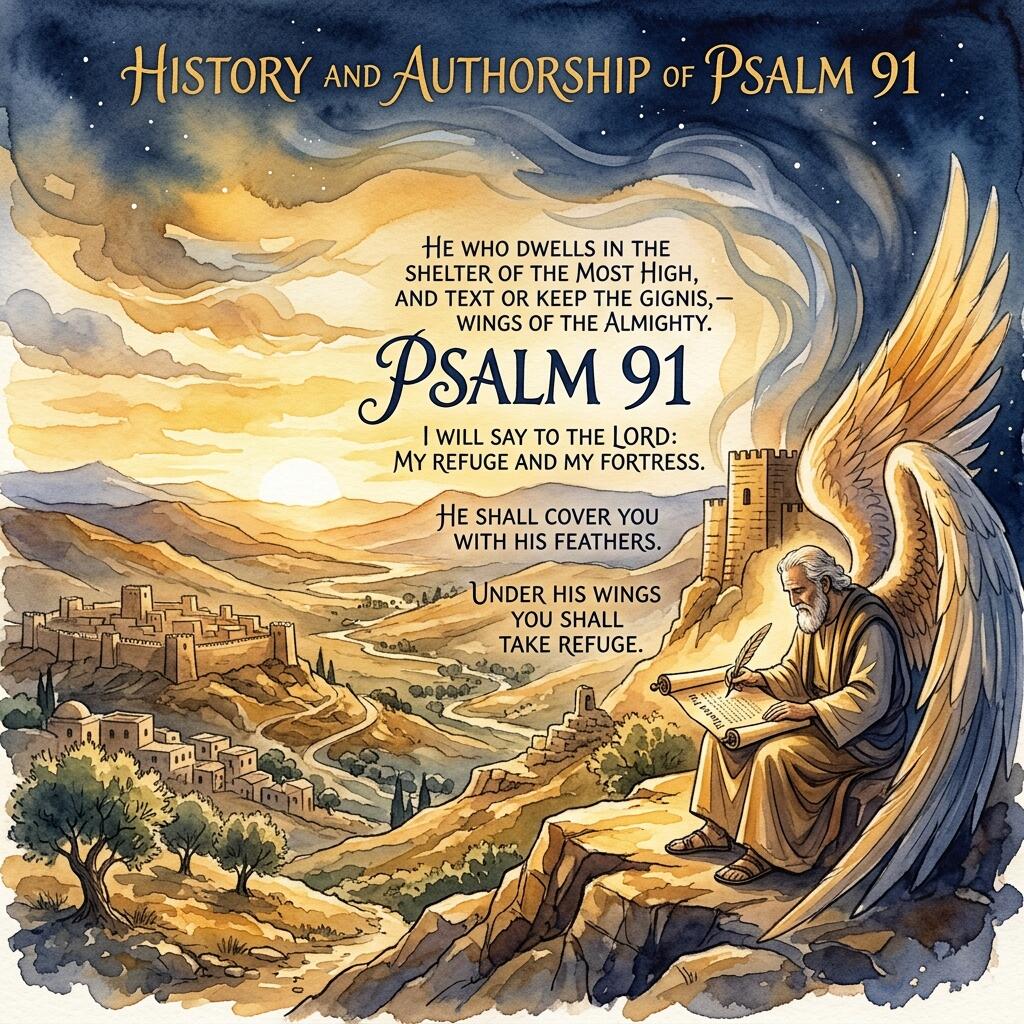
Psalm 91 is unusual in the Hebrew Psalter in that it carries no superscription — no heading identifying the author, occasion, or musical directions. The dominant tradition in rabbinic Judaism is that Moses wrote Psalm 91. The Talmud (Berakhot 10a) names Moses as the author, and the positioning of Psalm 91 immediately after Psalm 90 — which carries the superscription “A Prayer of Moses, the man of God” — strongly suggests a connection.
Those who favour Mosaic authorship point to the use of El Shaddai (Almighty) in verse 1 — a divine name especially prominent in the Pentateuch and in texts associated with Moses. Many scholars have argued that Psalms 90 and 91 were composed as a matched pair: Psalm 90 reflects on the frailty of human life before God’s eternity, while Psalm 91 responds with the security available to those who trust the eternal God.
Psalm 91 in the Structure of the Psalter
Psalm 91 belongs to Book IV of the Psalter (Psalms 90–106), a collection that many scholars believe was compiled in response to the trauma of the Babylonian exile. The overall message of Book IV seems to be: “Even though Jerusalem has fallen and the Davidic dynasty is in ruins, Yahweh is still King, and his faithfulness endures.” In this context, Psalm 91 functions as an intensely personal anchor — while the surrounding psalms proclaim God’s reign over the nations, Psalm 91 makes it personal: this cosmic King is your refuge, your fortress, your protector.
Three Thousand Years of Use: A Brief Survey
In Second Temple Judaism, the psalm was widely used in synagogue liturgy, particularly at the close of the Sabbath. Fragments found among the Dead Sea Scrolls suggest it was also used in protective rituals against evil spirits.
In early Christianity, the psalm was quickly incorporated into the church’s liturgy of protection. Early Christian soldiers carried it. The desert fathers of the third and fourth centuries quoted it in their writings on spiritual warfare. The Reformers wrote commentaries on it that emphasised its expression of trust in God alone.
In subsequent centuries, Psalm 91 has remained a constant companion through wars, plagues, and persecutions. During the Black Death, it was prayed over the sick and dying. During the World Wars, it was carried by soldiers and prayed by families waiting at home. In the COVID-19 pandemic, it experienced a remarkable resurgence of interest as people searched Scripture for comfort. Three thousand years on, it has not lost its power.
Practical Application: Knowing the History Deepens the Promise
Knowing that Psalm 91 has comforted and protected believers for three millennia — that the same promises that steadied a frightened soldier in 1916 or a plague survivor in 1350 are available to you today — adds a dimension of weight and tested truth to your own engagement with it. You are not reading words that have never been tested. You are reading words that have been tested by millions, in the worst possible circumstances, and found faithful.
A Closing Prayer
God of history, you inspired these words and have kept them alive through every generation. As I stand in this long line of your people who have found shelter in Psalm 91, I too declare that you are my refuge and fortress. Thank you for a word that has never failed. Let it not fail me now. Amen.